How to Fish a Crankbait
What a crankbait is, how the bill sets the diving depth, floating, suspending and sinking types, choosing a running depth for the water, the retrieve and its variations, and which fish take them, following Wikipedia, New York DEC and the Missouri Department of Conservation.
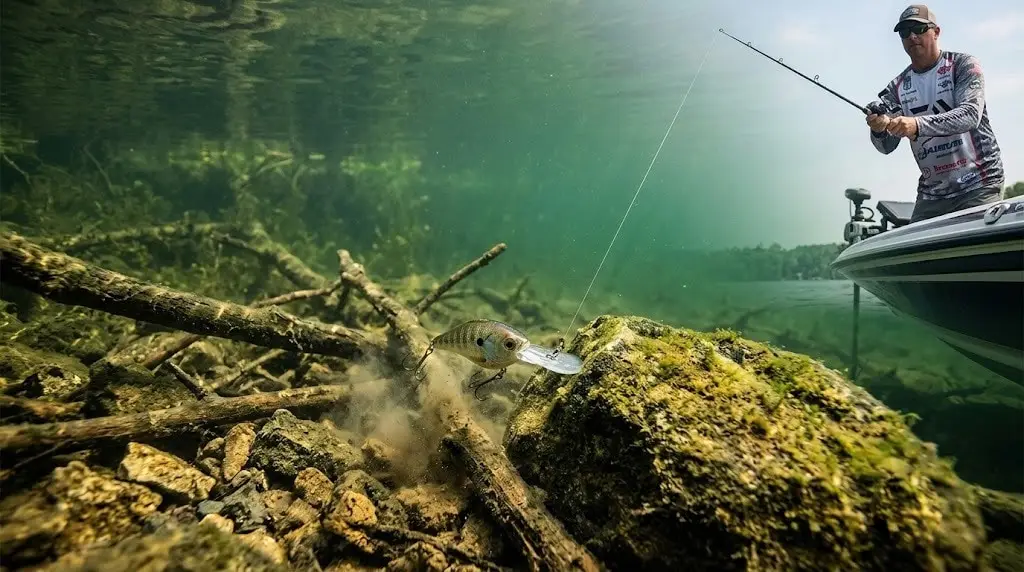
A crankbait is a hard-bodied lure with a short, stocky body, usually two treble hooks, and a bill at the front. Wikipedia explains that when you reel, the bill makes the lure pitch down and dive with small, fast side-to-side twitches, and the name comes from the steady cranking of the reel. This guide covers how crankbaits work, how to pick one for the depth you fish, the retrieve and the fish they catch, following Wikipedia’s article on plugs, New York DEC’s bass rig table and the Missouri Department of Conservation’s (MDC) bait guide. Our techniques section has more lure methods.
How a crankbait works
From Wikipedia:
- The bill sets the dive. How deep and how fast the lure dives depends on the bill’s design and the buoyancy of the body; a larger bill dives deeper, and the bill’s angle matters too. Lures are often named for it: “shallow-diver” or “deep-diver”.
- Most float. Bodies are usually lighter than water, so the lure dives while you reel and floats up when you stop.
- Some rattle: a small metal ball inside rattles on the retrieve.
- Size: plugs run from about an inch to about 8 inches, with 2-3 inches the most common. As a general rule, large plugs for large fish and small plugs for small fish.
Three types
Wikipedia’s classification:
- Shallow-diving (floating): runs a few feet down while reeled and floats to the top when you stop.
- Suspending: dives when reeled and stays at that depth when you stop.
- Deep-diving (sinking): sinks when not reeled and holds a consistent depth when reeled.
Two related lures: the jerkbait, a slender minnow-shaped plug with a short, steep bill, worked with rod flicks (see how to fish a jerkbait), and the wobbler, with a short bill that makes it roll rather than dive.
Pick the running depth for your water
DEC’s advice for bass: choose a crankbait that runs at the depth you’re fishing. Its example: in 12 feet of water, pick one with a running depth of 10-15 feet, in crawfish or shad colours, for shallow to deep water. Our reading water guide helps you work out the depth and structure you are fishing.
The retrieve
- DEC: a straight retrieve with occasional pauses.
- Wikipedia: most plugs have their action built in, but anglers vary it by changing the retrieve speed, twitching the rod tip, or stopping the lure completely and then reeling fast. With a floating crankbait, a pause lets it rise; with a suspending one, it hangs in place.
- Target cover: Wikipedia notes plugs are often cast to land next to places fish may hide, such as a snag pile or an overhanging tree, and worked back; by casting and retrieving steadily you can search many likely spots.
Which fish take crankbaits
MDC’s bait guide lists crankbaits for bass and walleye, small crankbaits for crappie, and says catfish occasionally take them. MDC also calls trolling crankbaits that dive to various depths probably the most common walleye method. See our largemouth bass and smallmouth bass profiles.
Tackle
DEC’s go-to bass setup is a 6½-7-foot medium-action spinning rod with 8- to 10-pound monofilament, with a baitcasting rod and fluorocarbon or braid as the more advanced option. Our guides to spinning vs. baitcasting and choosing fishing line cover those choices.
Sources
- Wikipedia, Plug (fishing), sections on crankbaits and jerkbaits. Read 28 October 2026.
- New York State DEC, Fishing for largemouth and smallmouth bass. Read 28 October 2026.
- Missouri Department of Conservation, Bait and lures and Walleye and sauger: fishing tips. Read 28 October 2026.
Recommended Gear on Amazon
- Squarebill crankbaits - browse current options and reviews on Amazon.
- Cranking rod - browse current options and reviews on Amazon.
- Fluorocarbon line - browse current options and reviews on Amazon.
As an Amazon Associate, we earn from qualifying purchases - at no extra cost to you. This helps us keep producing free, in-depth guides.